
A slot multiplier needs a defined base
A slot multiplier modifies an amount or value identified by the rules. Before applying it, ask what is being multiplied: one line award, a symbol value, a cascade subtotal or a final feature total?
A visible “5×” is incomplete information until its target and timing are known. It might apply to a qualifying win, remain stored for a later stage, or require another condition before it is used. Do not treat every displayed multiplier as an immediate cash award.
Slot multiplier math: addition and multiplication
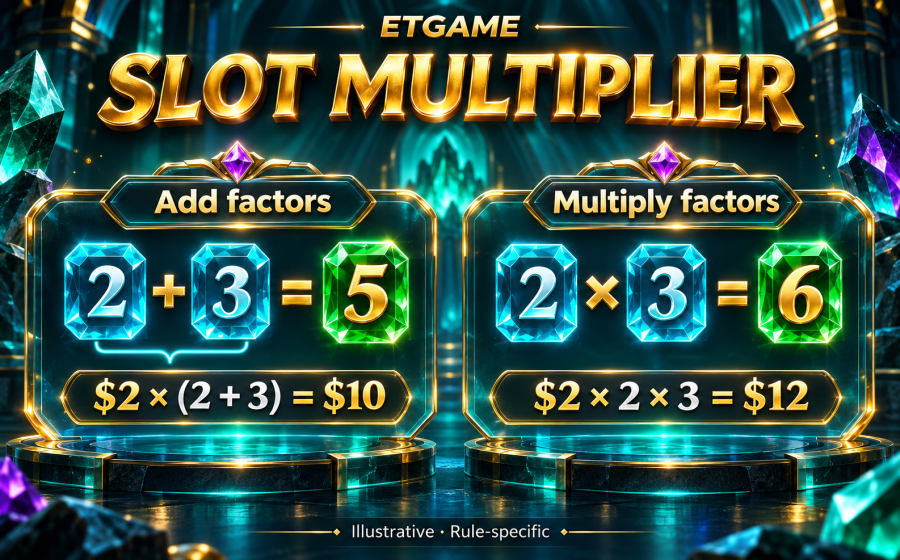
Invented rules: assume a fictional $2 qualifying award and two values labeled 2× and 3×. If its rule adds the values first, the combined factor is 2 + 3 = 5 and the award is $2 × 5 = $10. If a different fictional rule multiplies the factors, the result is $2 × 2 × 3 = $12.
| Stated operation | Calculation | Result |
|---|---|---|
| Add factors, then apply | $2 × (2 + 3) | $10 |
| Multiply factors | $2 × 2 × 3 | $12 |
These examples show why the operation matters. They are not two selectable interpretations of one game: use only the operation its actual rules specify.
The order of application also matters
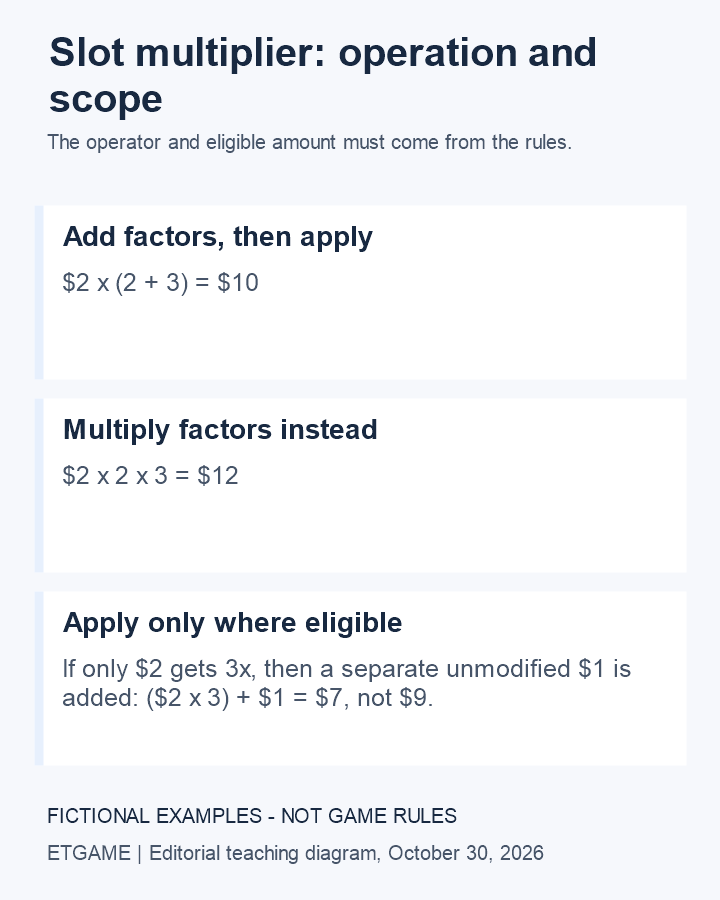
Invented sequence: a fictional round contains a $2 subtotal with an eligible 3× modifier, followed by a separate $1 award that has no modifier. Applying the modifier only to the first part gives ($2 × 3) + $1 = $7. Applying it to everything would give ($2 + $1) × 3 = $9, which would contradict the stated example.
Write the eligible components first, then put brackets around the amount the multiplier actually modifies. This is especially useful when a sequence contains several evaluations before settlement.
The public mechanics guide explains why an evaluation and a follow-up action are separate concepts. A longer sequence does not tell you that one factor applies to every component.
Official examples use different operators
Hacksaw Gaming’s Wanted Dead or a Wild description says that qualifying DuelReels values are added when several share a winning combination. The same developer’s Chaos Crew 2 page describes Cranky Cat factors multiplying one another on a shared winning payline.
The useful distinction is the documented operator and its scope, not the fact that both games display multiplier symbols. Keep each statement attached to its named feature and version. This is a comparison of published descriptions, not a report of testing either game.
Check persistence, reset and limits last
After the arithmetic, ask when a factor is retained and when it resets. A factor that lasts to the end of one sequence is different from one carried across several bonus spins. A cap or an exception may also change the final payable amount.
Finish with one complete note: “Apply [operator] to [eligible amount] at [stage], retain until [event], subject to [stated limit].” Leave unknown parts unresolved instead of filling them with another game’s rules.
For another feature-reading example, the public Money Train 2 profile separates character values from the final bonus total. A displayed value, a calculated intermediate value and a settled award are not interchangeable records.

Discussion