
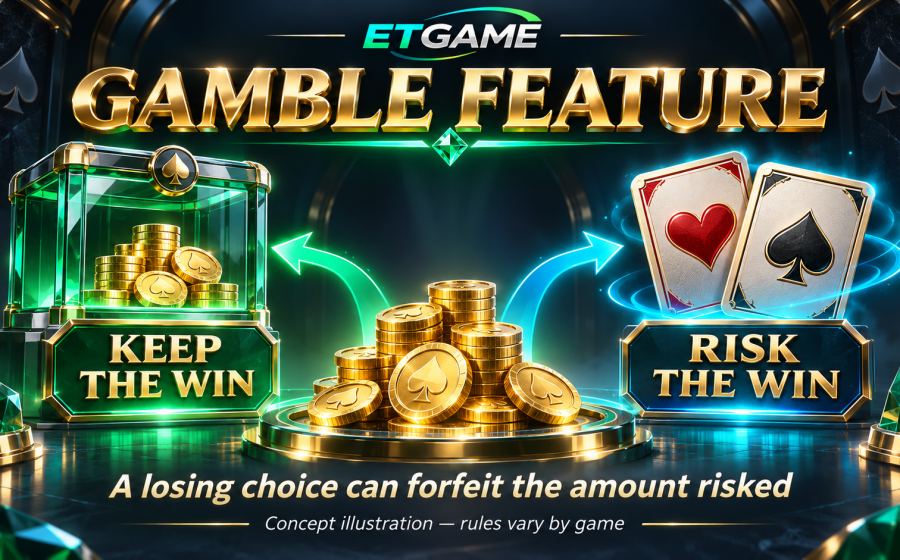
In gamble feature slots, an optional decision can put an existing award at risk after a winning result. The important question is not just how much the next screen might pay, but how much of the current award can be lost. This guide follows that amount through the decision and separates an after-win gamble from a bonus purchase or a higher-priced spin.
What is at stake in gamble feature slots?
An eligible win and the amount offered to gamble are separate quantities. A game may make only certain awards eligible or place a limit on what can be risked. Read that offer before assuming the whole displayed balance is involved.
A collect choice generally retains the eligible award under that game’s settlement rules. It is not the same action as withdrawing money from an operator account. A gamble choice submits the stated amount to another outcome; a losing result can forfeit it. The exact loss, possible partial stake, ties and repeat limits must come from the matching rules.
Follow the award through two settlement stages
First identify the completed slot award. Next, identify the separate amount committed to the optional gamble and the final result that replaces it. Do not add an earlier amount again when the later display already includes it.
Hypothetical example: an eligible $4 award is risked in full on an all-or-nothing option that returns $8 on success or $0 on failure. Success leaves $8 from that decision, not $4 plus $8. Failure leaves $0 of the amount risked. These numbers describe an invented example, not a named game’s paytable.
For the entire paid round, compare the final retained return with the original paid cost. If that original spin cost $1, retaining a $4 award gives a $3 net change for the round. A later $8 return would give $7; losing the whole award would leave a $1 net loss for that round. Do not confuse the change from the gamble with the round’s complete result.
A hypothetical probability calculation
For the invented $4-to-$8-or-$0 example, an assumed 50% success probability gives an average return of 0.50 × $8 = $4. If the assumed probability were 45%, it would be 0.45 × $8 = $3.60. Neither calculation predicts an individual result.
More generally, if a successful outcome returns m times the amount risked and failure returns zero, its average return is the amount risked × p × m. Breaking even against retaining that amount requires p = 1/m, under those assumptions. Fees, partial returns or ties change the calculation.
A red/black image does not establish a fair 50/50 choice. The rules must establish the actual outcome model. These illustrative probabilities are not verified figures for Belatra or any other developer, and they do not establish an increase in the underlying slot’s RTP.
How gamble feature slots differ from paid bonus entry
Belatra’s 88 Dragons Bounty product page describes a Risk Game involving main-game winnings, including card color/suit and dealer-comparison options. That is evidence for an after-win risk feature in that named product. The short product description does not supply every probability or tie rule.
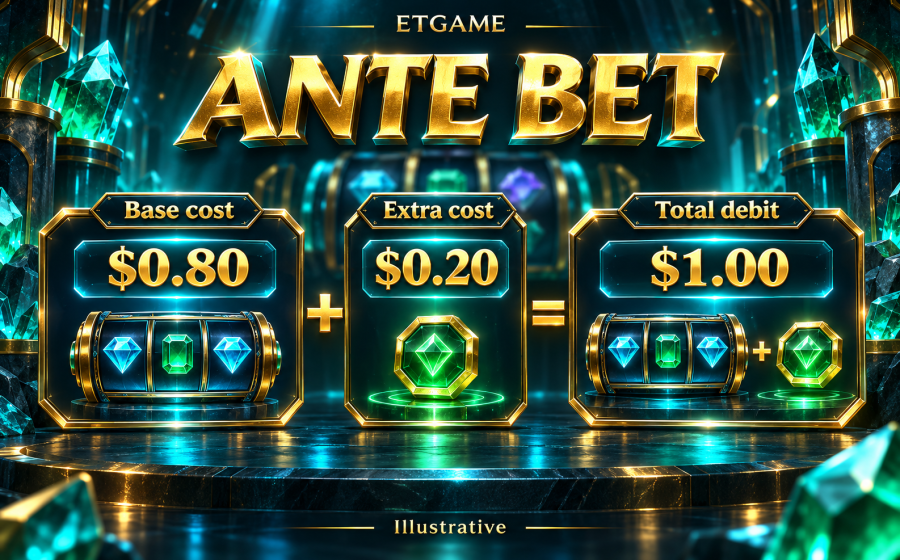
Mummyland Treasures documents different optional transactions: Craft Bonus purchases a bonus, while Bet +25% changes the cost of a main-game spin. Those descriptions do not establish a post-win card gamble in Mummyland Treasures. Keep the examples attached to their own titles.
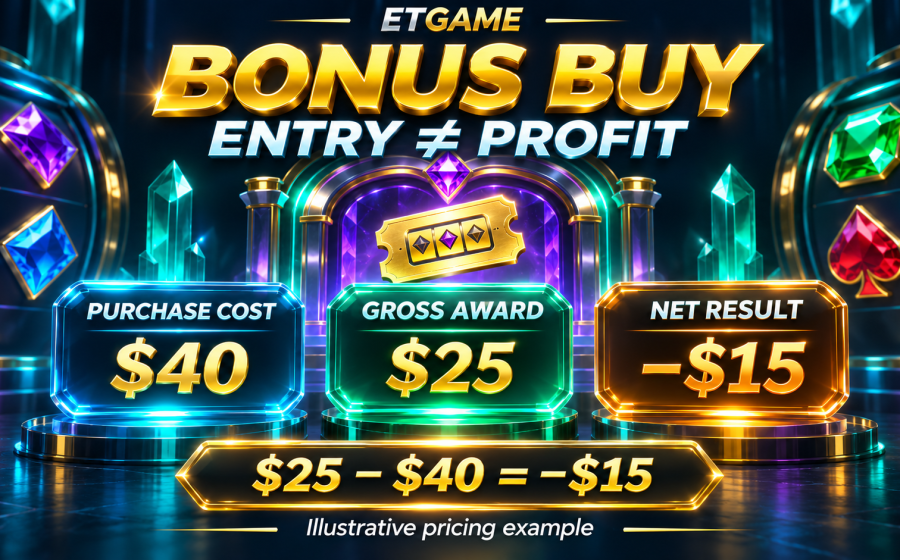
A bonus purchase spends a stated price to enter a feature. An ante-style bet changes a paid spin’s cost or conditions. An after-win gamble risks a stated existing award. Similar labels such as Double, Boost or Bonus do not make these the same transaction.
Check limits before reading the final balance
Check eligible award types, the minimum and maximum risk amount, whether only part of a win can be used, the successful return, the losing or tie result, and any limit on repeated attempts. An operator’s promotion is a separate set of conditions from the game’s own rules.
If an example’s $4 becomes $8 and the full $8 is offered again, the new amount at risk is $8. It is no longer accurate to describe the next loss as risking only the original $4. A previous success does not reveal the probability of the next attempt.
For a final cross-check, use the game-rules checklist: identify the exact edition, read the eligible amount and conditions, and record one final settled result. Leave an unknown probability unresolved rather than filling it with a card-game assumption.
Sources and scope
Official references reviewed November 12, 2026. Hypothetical examples explain the calculations; they are not recorded game results.


Discussion