
Why Sic Bo odds need two separate checks
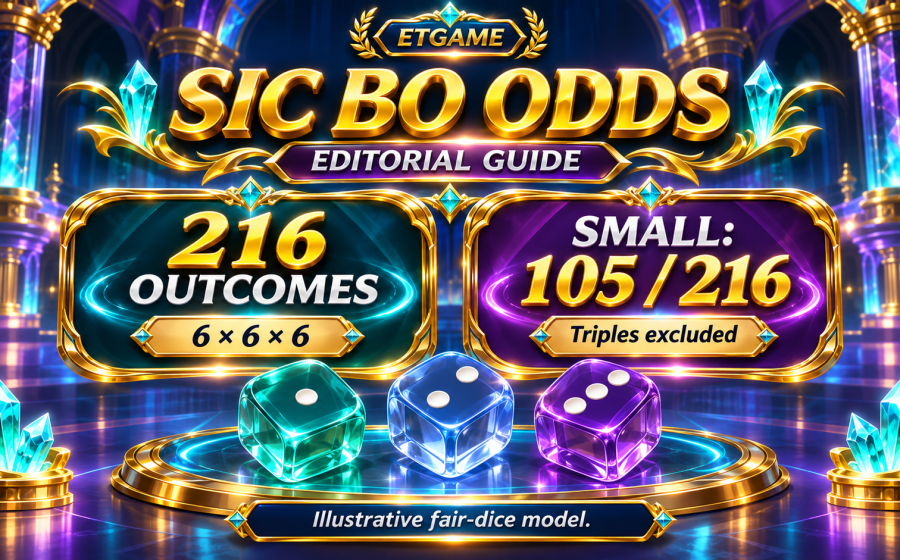
Sic Bo odds depend on the result you cover and the amount a winning wager pays. With three fair, independent six-sided dice, there are 6 × 6 × 6 = 216 equally likely ordered results. A larger advertised payout does not by itself identify the more likely result.
Sic Bo odds: count ordered results, not just different-looking sets
The results 1–2–3 and 3–2–1 have the same total but occupy different places in the 216-outcome model. A particular triple, such as 4–4–4, has only one ordering. Any triple covers six outcomes, so its model probability is 6/216, or about 2.78%. These are mathematical counts, not measurements of an online game.
Big and Small: the triple exception matters
Crown Melbourne’s cited rules define Small as totals 4–10 and Big as 11–17, with triples losing on either wager. In this specific rule model, each side wins on 105 of the 216 outcomes: about 48.61%, rather than 50%. For example, 3–3–3 totals nine but loses on Small because the triple exclusion takes priority.
Worked example: probability versus payout
Assume a 1-unit Big or Small wager pays 1:1 profit and uses the triple exclusion above. Across the model’s 216 equally weighted outcomes, profit is 105 × 1 − 111 × 1 = −6 units. Dividing by 216 gives an expected loss of about 0.02778 units per unit wagered. This is an average over the model, not a forecast that every block of 216 rolls loses exactly six units.
Changing the paytable changes the calculation
A total of ten has 27 ordered outcomes in the same dice model. If a hypothetical paytable pays 6:1 profit for that total, the calculation is (27 × 6 − 189)/216 = −12.5%. The 6:1 rate is an illustrative assumption here; it must not be substituted for a different table’s actual rate. Multiplier variants also need their own complete rules.
What to verify in the game help
Record the dice model, covered outcomes, triple exclusions, profit-payout notation and any multiplier layer. Calculate each wager separately before combining its net result with other wagers. The paytable reading guide explains why a displayed ratio must be matched to its stake unit; this dice example does not turn a slot paytable into Sic Bo rules.
Sources and scope
References checked November 23, 2026. Calculations are editorial examples, not played results.
Discussion