
What en prison roulette changes
En prison roulette changes the settlement of eligible even-money wagers when zero appears. Instead of immediately treating the whole stake as a normal loss, the stated rule can hold it for a later spin. It does not turn every losing roulette wager into a second chance, and a single-zero wheel does not automatically include this option.
Identify the eligible bet first
Barrière’s French roulette explanation applies the rule to its simple chances. These include red/black, odd/even and the low/high ranges, rather than straight-up numbers, splits or dozens. First identify the wager category and then its zero rule. A winning straight-up bet on zero is a different wager with its own payout.
Worked example: locked is not paid
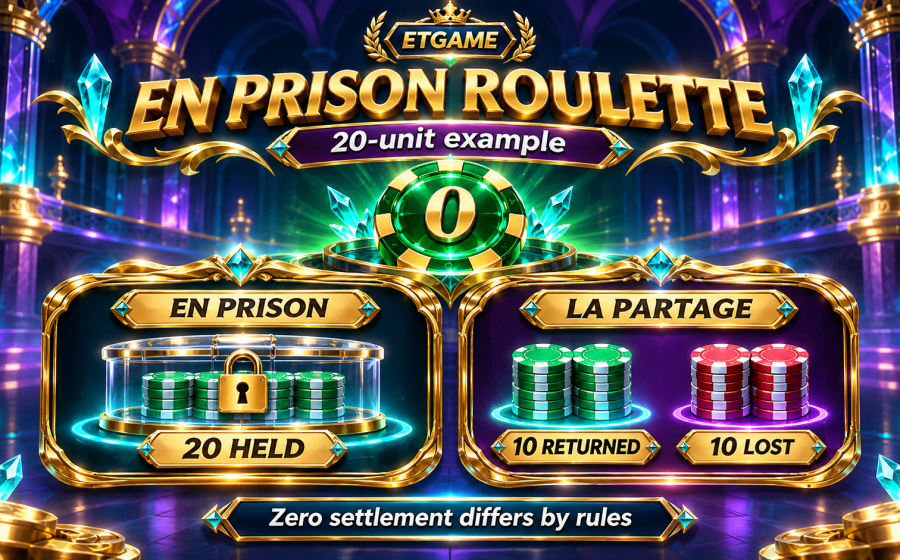
Suppose 20 units on red are placed under the cited en prison arrangement and zero lands. The stake is held. If the next result releases that stake because red wins, the returned 20 units restore the original stake; they are not 20 units of new profit. If the applicable next result loses, the held stake is lost. The example deliberately stops before the repeated-zero case.
Repeated zero must have its own rule
Do not infer what a second zero does. Barrière explicitly describes a further requirement after zero repeats, involving two consecutive occurrences of the chosen chance to recover the stake. Other implementations may differ. If the displayed help does not explain repeated zero, the settlement remains unresolved; the first-zero explanation cannot fill that gap.
La partage settles part of the stake immediately
In the cited Monaco Roulette Monte-Carlo rule, an even-money stake loses half its value when zero appears. With 20 units, that means a ten-unit loss and ten returned. This immediate half-settlement differs from keeping a stake locked under en prison. Neither label should be applied to an unrelated online roulette product simply because its interface looks French.
Compare versions without mixing wheel and settlement
Record the wheel’s zero count, eligible wagers, first-zero treatment, repeated-zero treatment and whether a released stake earns profit. Then compare with the American roulette rules guide. The references are named rule examples, not a claim that every French or European roulette table follows one universal rule.
Sources and scope
References checked November 23, 2026. Calculations are editorial examples, not played results.
Discussion