
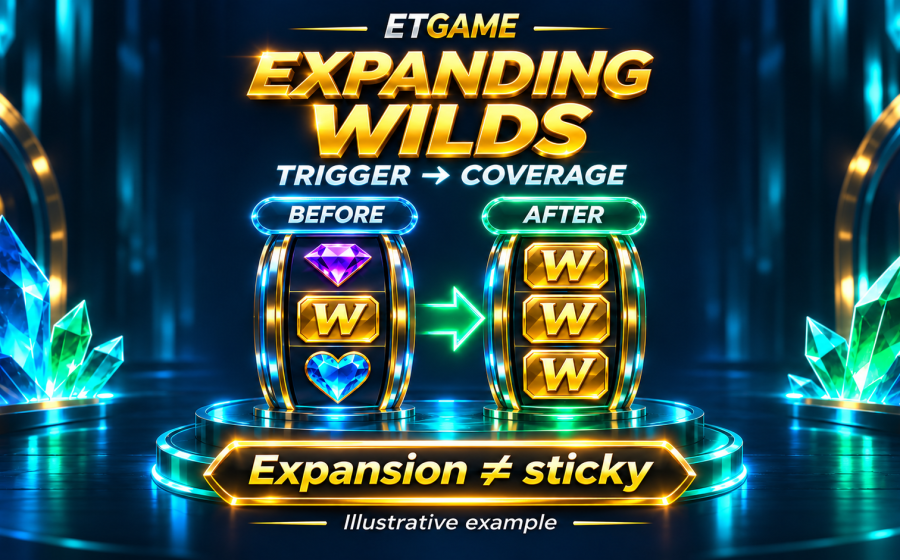
Expanding wilds grow beyond their initial symbol position to cover a larger part of the reel area. To interpret them, ask three questions in order: what activates the expansion, which positions become wild, and when the game evaluates the changed layout. Coverage alone does not explain the whole feature.
When expanding wilds activate
Some rules require an active feature, a particular reel or a specific stage before a wild expands. A normal wild can therefore appear without the full expansion behavior you expected. Read the condition as an if-then statement rather than assuming every wild animation has the same effect.
Medallion illustrates why conditions matter. Its published materials connect expanding wild behavior with the wild-stone feature. Relax Gaming’s product description also gives that expanded reel a wild multiplier. That does not make expansion and multiplication a single universal rule.
Check coverage and evaluation timing separately
In a hypothetical three-row reel, one wild expands to fill the other two positions. If the rules evaluate paylines after expansion, all three positions can contribute to eligible substitutions. If a feature instead grants a new respin, that later action needs its own evaluation. Do not count both an imagined pre-expansion award and a post-expansion award unless the rules explicitly pay both.
On a line game, trace the actual line through the expanded reel and the neighboring symbols. On a ways game, count eligible symbol positions under that game’s matching rules. A tall wild with no qualifying match elsewhere can still produce no award.
Expanding wilds and sticky duration
Expansion answers how much area becomes wild. Sticky behavior answers how long it stays. A feature can include both, but the instructions must say so. Print Studios’ Huntress: Wild Vengeance explicitly combines full-reel coverage with a sticky-wild respin and a separate global-multiplier mechanism.
That combination is a named example, not a property of every expanding wild. Nor should an expanding regular symbol automatically be renamed a wild: a large symbol that fills several positions may still represent only its own symbol type.
Read the multiplier as another rule
When a multiplier appears, establish whether it applies to a win using that wild, every line win, a whole cascade sequence or a later stage. Check how several multipliers combine and when they reset. The height of the expanded symbol cannot answer those questions.
A useful reading sequence is activation → coverage → evaluation → duration → modifiers. This makes it possible to explain what changed without promising a win or inventing probabilities. Use the rules checklist to find missing conditions and the version guide when two descriptions disagree.
Sources and scope
Manufacturer references checked November 6, 2026. This is an editorial rules overview, not a record of hands-on play.



Discussion