

Slot RTP meaning starts with the denominator
Slot RTP meaning centers on an average: theoretical RTP compares expected prizes with stakes over a large body of play under the game’s mathematical model. It is not the probability that a spin wins, and it is not a guaranteed share of your deposit.
The UK Gambling Commission’s player explanation of return to player stresses that the average does not describe what must happen in each session. Read the percentage together with the exact version and the mode or configuration it covers.
Theoretical return and observed return are different records
Theoretical RTP comes from the design model. Actual RTP describes recorded activity over a specified sample: total prizes divided by total stakes, multiplied by 100. One is a property of the stated design; the other is a measurement with a time window and sample.
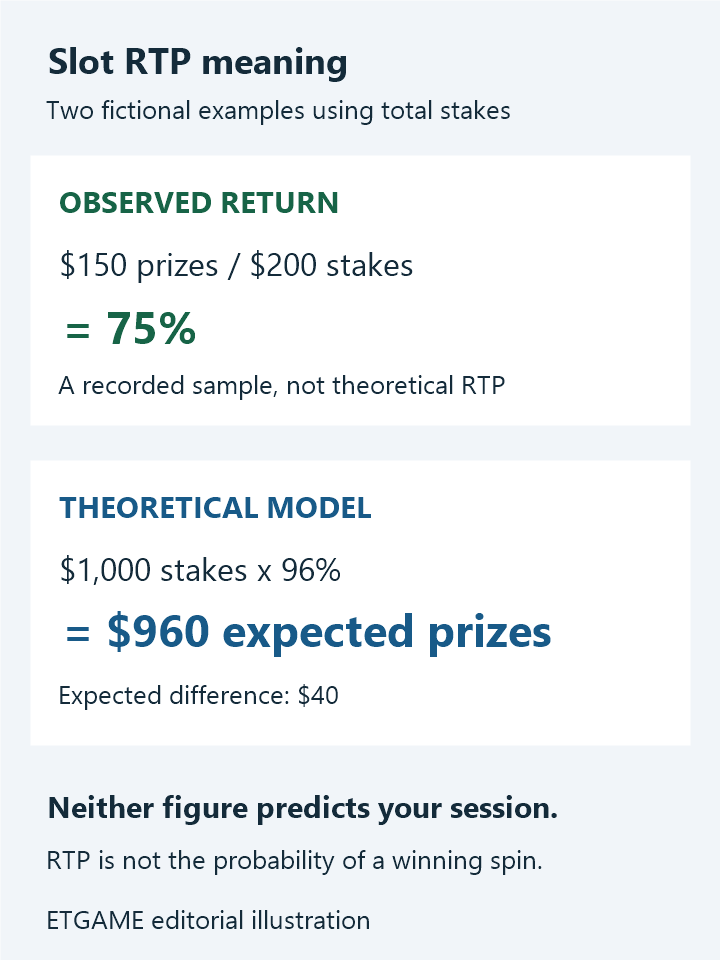
Invented example: a fictional record contains $200 in total stakes and $150 in prizes. Its observed return is $150 ÷ $200 × 100 = 75%. The recorded net result is $150 − $200 = −$50. Neither calculation establishes the game’s theoretical RTP.
Keep the source of a displayed percentage clear. A product specification, a user’s recent results and an operator-wide dashboard may cover different things, even if each uses the letters “RTP.”
A deposit is not total turnover
Turnover includes every stake in the measured activity, including stakes made using previous prizes. A $50 deposit can therefore support more than $50 of total stakes if money is repeatedly staked; it can also support less if some is never used.
Invented bookkeeping example: a fictional player makes ten $1 stakes, then another ten $1 stakes using money already in the balance. That is $20 of turnover, not $10. If you divide prizes by the initial money added instead, you are calculating a different ratio.
Do not mix cash-balance changes, promotional credits and game payouts without a defined accounting basis. Use the same included transactions in both parts of any comparison.
Slot RTP meaning in a 96% model
In a simplified model with a 96% expected return, $1,000 of stakes corresponds to $960 in expected prizes and a $40 expected difference. This is arithmetic about an expectation, not a forecast that the next $1,000 of personal play will produce those amounts.
Actual results can differ because outcomes vary. More recorded play gives a larger sample, but it does not guarantee recovery of earlier losses or create a stopping point where the model owes you money. A theoretical figure also does not tell you the sizes and frequencies of individual prizes.
The Commission’s guide to measurement volume and volatility explains why sample size and volatility matter when interpreting a measured result.
Check the version before comparing percentages
Manufacturer pages can list several available configurations. For example, Habanero’s Koi Gate product page explicitly lists multiple RTP options. That is evidence of options, not confirmation of which one a particular website has installed.
Write down the full title, configuration shown in the game, source and check date. If the actual configuration is unavailable, keep the comparison unresolved rather than choosing the highest number from a catalog.
The public Money Train 2 profile shows how a feature explanation can remain useful while keeping numerical configuration checks separate. Understanding a game does not require pretending that a missing percentage is known.
Discussion