
Cluster pays awards a qualifying group of matching symbols. The group must first satisfy its connection and size conditions; only then does the paytable determine the award. A cascade describes what happens after a result is evaluated. Group qualification, prize value and the next layout are three separate parts of the process.
Cluster pays: five matching symbols may form no qualifying group
Consider a fictional rule: at least five A symbols must connect through shared edges. Four connected A symbols and one isolated A do not make a five-symbol group. Neither do two separated groups of three, even though the screen contains six A symbols in total. Count each connected component before applying the size threshold.
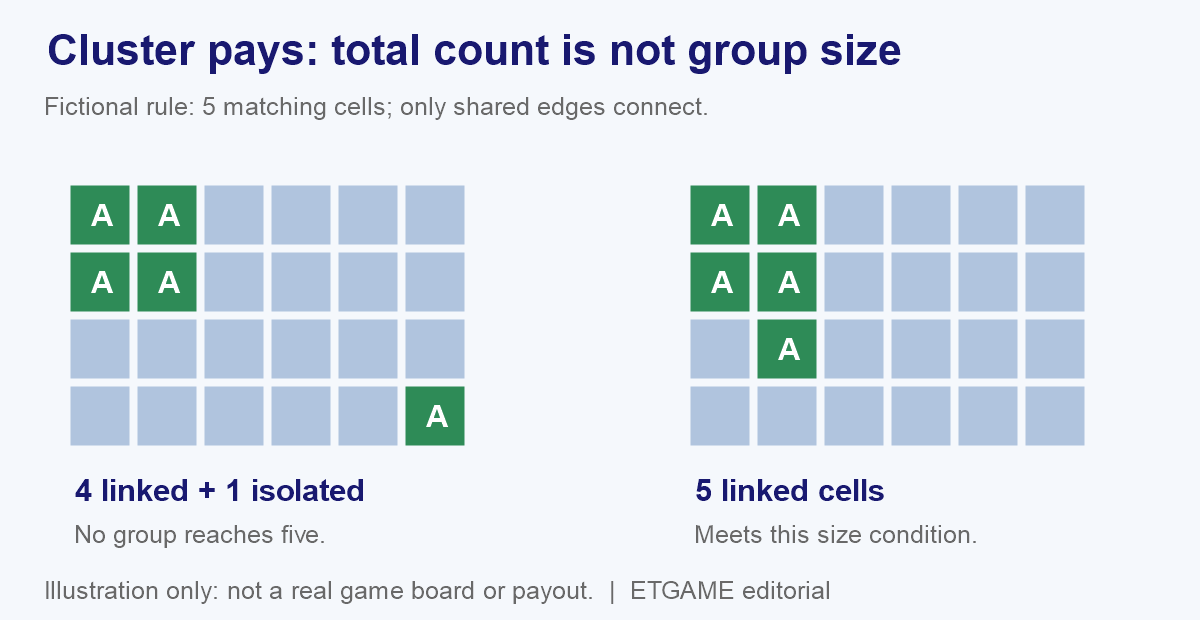
Under this invented rule, diagonal contact alone is not an edge connection. An L shape can still qualify, because a group need not be a straight line. If a real game defines adjacency differently, use that definition instead. The example explains the counting method rather than assigning one connection rule to all slots.
A worked cluster payout: group size is only the first step
Assume this fictional paytable for symbol A. It uses the total paid stake as the calculation basis, and a single stated multiplier applies to the qualifying group. None of these amounts is taken from Jammin’ Jars or another real game.
| Connected A symbols | Fictional award |
|---|---|
| 5–6 | 0.4x stake |
| 7–9 | 0.8x stake |
| 10+ | 2x stake |
With 8 connected A symbols, a $2 stake and a qualifying 3x multiplier, the illustration pays $2 × 0.8 × 3 = $4.80. The size chooses the 0.8x band; it does not mean that each of the eight symbols earns $0.80. The 3x factor multiplies the group award, not the number of cells.
A different symbol could use a different band, even at the same group size. Two separate qualifying groups may also require separate calculations. The real paytable must define its symbol values, bands and treatment of shared Wilds; the fictional table does not answer those game-specific questions.
Cascades are additional evaluations within a sequence
After a qualifying win, a cascading game may remove the winning symbols and fill the gaps, then evaluate the new arrangement. Push Gaming’s Retro Tapes announcement explicitly describes that removal-and-refill process. Its effect is to produce another chance for a group within the continuing round, rather than to purchase another starting round.
- Starting paid round → evaluate the first layout.
- Qualifying group → calculate its award.
- Removal and refill → evaluate the new layout under the active rules.
- Continue or end according to the game’s sequence and feature conditions.
That sequence is distinct from a free-spin balance. A game can have several cascade evaluations inside one free spin. Counting each falling-symbol animation as an extra awarded free spin would confuse an internal step with a separate entitlement.
Do not add a running total twice
In a fictional $2 round, suppose the first evaluation awards $1 and the second awards $2. A third produces no award and ends the example. The total return is $3 and the net change is $3 − $2 = +$1. If a display showed running totals of $1 and then $3, adding those displays would incorrectly produce $4.
The important distinction is between individual awards, a cumulative round total and net change after the paid cost. A bright win animation may show one of those values without explaining the others. Identify the value being displayed before comparing results.
Compare the win rule before comparing board size
| Format | What establishes a qualifying result |
|---|---|
| Paylines | The symbol combination must meet the relevant listed line and award rule. |
| Ways | Eligible symbols must meet the required reel sequence. |
| Cluster pays | A matching group must meet the game’s connection and size rules. |
| Cascade | A process following an evaluation; not a separate win-system definition. |
Jammin’ Jars uses an 8×8 layout, while Retro Tapes uses 6×9. Both manufacturer descriptions refer to matching at least five symbols. The layouts contain 64 and 54 cells respectively, but that arithmetic does not compare their win frequencies, returns or feature behavior. Their special-symbol and stage rules still matter.
The studio directory can identify the developer behind a title. For the mechanics themselves, keep four questions separate: does the group qualify, what does it pay, what changes next, and which effects persist into another stage?
Sources
- Push Gaming — Jammin’ Jars
- Push Gaming — original Jammin’ Jars release announcement
- Push Gaming — Retro Tapes release

Discussion